
Q&A WITH DAVE LORY (NEW MUSIC SEMINAR, WORLDWIDE ENTERTAINMENT, INC.)
posted in: Features • Music News • OurStage Updates
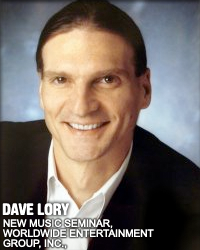 The saying goes, “Nice guys finish last.” Not so in the case of 30 year industry vet and genuine sweetheart, David Lory. His career has spanned genres and multiple music-related businesses. He has experienced triumphs and heartache while on the job. Yet when you meet him there is no trace of superiority; he’s just a regular guy who is genuinely passionate about music and excited to share his knowledge with others. To this end, Lory took time out to talk to me about his career and latest endeavor, co-directing the New Music Seminar.
KB: Summing up your music industry background is a bit intimidating. You’ve worked for the major labels and helped launch independent label ventures. Your experiences span the worlds of artist management, tour coordination, publishing, event production, artist development and marketing. You are one of the few executives that have worked in every major genre of popular music including rock, pop, country, folk, classical, jazz, hip hop and R&B. You revived the careers of the Allman Brothers, Cake, Lucinda Williams and Elvis Costello. You broke Jeff Buckley and the Mighty Mighty Bosstones internationally; managed Courtney Love and Duncan Sheik, and turned Shania Twain and Hanson into platinum-selling superstars. And that’s just the tip of the Dave Lory proverbial iceberg! Through all these experiences, what has been one of the most fulfilling moments in your career?
DL: There are definitely many, but my biggest high and low points were associated with managing Jeff Buckley. The high points were getting him off tour support [into a headlining role] from the major label within the first year without any radio airplay. He then had a career for the rest of his life regardless of radio airplay or having an album out in order to tour and make money HIS way. That was awesome. That was the best ride in breaking an artist globally a manager could ever have. Columbia Records during those days was amazing with Donnie Ienner, Michelle Anthony, Steve Berkowitz and Missy Worth and the rest of the team there. Everything just clicked on anything and everything we did. Of course when you have the talent that Jeff had, our jobs were pretty easy. Making an artist’s dream come true is the most rewarding part of the business.
Starting up Artemis Records with Danny Goldberg was pretty exciting. Being named Billboard‘s Independent Label of the Year our first two years and then having all those GRAMMY nominations as well. I was able to deal directly with some of the coolest artists like Warren Zevon, Steve Earle and Rickie Lee Jones just to name a few. It was a real family atmosphere and Danny has always been a great artist person to work with, so the vibe the first three years was amazing and a fun place to work. Of course, we also had the hit Who Let the Dogs Out which did not hurt. That was one of those songs you just got out of the way as it just exploded out of nowhere. “MMMBop” was another song that did the same thing by Hanson. We broke that song when I ran Mercury International prior to Artemis. Those types of songs you just cannot explain the rush you feel when you see and hear it happening and what was fun about the old music business as I call it now.
KB: Have there been any lows? How did you get through the lows?
DL: The low point was obviously when I got the call that Jeff Buckley was missing in the Mississippi river. I will never forget that call at 6:00 am when I was in Dublin and it is still so vivid in my head. There is no telling what he would of done creatively by now and I will probably never witness this type of talent again in my career. He was also a very good friend who cared about people a great deal. In fact, an hour before he disappeared he called my house to say hi to my wife to make sure she and my daughter were okay as he knew I was traveling. I met my wife through managing him as she was his promotion manager in Europe, so he left me a great legacy with her and two beautiful daughters. I miss him a lot.
It was tough getting through it as all these people came out of the woodwork to try to capitalize on his career to make their career bigger, many of whom did not have a very big career at the time. There were lawsuits and it took me four plus years before I could listen to his music, plus every time I saw my wife and daughter it reminded me of him. I had some good people like Danny Goldberg and Janet Billig, who dealt with Kurt Cobain‘s death, who guided me through some of the perils and things you needed to do with the media and other things. I did the same thing years later with Michael’s manager with INXS. There is a small group of us that you do not want to be a part of and that is tragic deaths in the music business. Now I listen to Jeff’s music and count my blessings I played a small part in his legacy and in his life.
KB: You’ve been working in music for the past three decades. Why do you think you’ve been able to stay in the game and have continued to enjoy success in spite of all of the inherent changes within the industry?
DL: Probably because I am a jack-of-all-trades and master of none (Laugh). Fortunately I have worked on my own most of my career and did a lot of different things, so it has enabled me to adapt, learn a lot about many areas of the business and keep working. I have also had some great mentors in the business like Danny Goldberg, Richard Broderick (who ran NYU‘s Music Business program when I was there and a legend in the early days of the business) and now back working again with Tom Silverman, all of whom I have great respect for.
KB: Recently you’ve added Co-Director of the New Music Seminar to your resume. What inspired you to take on a music conference geared towards empowering artists to take control of their careers and success?
DL: Tom Silverman and I have wanted to work on something together for a while and tried to do it with other companies over a year with different models we were trying to put together, but none of them came through. Although the music business was talking of change, no one would actually take the steps to do something about it. Tom and I were also frustrated with where the business was going because no one saw the benefits of these changes, especially from the artist side, so we brought back the New Music Seminar to create that change in the music business with others for the good of the artistic community.
I have always been about the artist in my career. If I can help make a difference to artists in providing a platform for them to succeed, then there could nothing more satisfying or special in my career at this point.
KB: If you could sum up the top five ingredients it takes to have a career in music what would they be?
DL: 1. Believe in Yourself… At the end of the day no one else will unless you do. Years ago, I asked an A&R person in Nashville why she took a meeting with me on an artist even though I did not know her. She told me it was because I believed so much in the artist over the phone, that she had to see what it was all about.
2. Be Nice… No matter how bad people treat you, treat everyone with respect. Your career will be a roller coaster and you go up and down. You want people there during the low times, so do not get too full of yourself when you are having success. Believe me, it will end and you will be onto something else new again.
3. The Artist ALWAYS Comes First¦ This is why we are here. They are the reason we have a job, and without them and their talent there is no music business. I have turned down a lot of deals in my career that would of set me up financially, but would of killed an artist’s career. It is their career, not yours, you are working on so remember that at all times.
4. Enjoy the Ride¦ Too many times, especially artists, they are so focused on what they do not have success-wise and do not take the time to enjoy the ride to success while they are having it. Always enjoy the ride and the moment at hand.
5. Mentor Someone Younger and New to the Business¦ I teach at New York University and William Patterson‘s music business programs. I cannot tell you the joy I get from giving these kids all the information I have from my experiences, both good and bad, so they can use it to their advantage and not make the same mistakes I did.
KB: Do you think that the playing field is level for all genres of music?
DL: I think it is. It is just that some genres become more popular at times than others. I love it when you see things in the media like Rock is back! It never went anywhere, it was just a new form of music came along like hip hop. Now hip hop is the new pop and so on. I think the only thing that upsets me in entertainment now is like fast food with reality TV, American Idol and Disney, which are the only artists breaking big and fast, but most stars in these shows do not last. They are not hungry because it came easy to them and I have worked with some of these artists and they just do not want to put in the work.
KB: Can the talented and hardworking as well as the unknown new world of the music industry overcome the challenges of the economy?
DL: If you are talented, people find you and you will succeed. If you are not talented, you have to realize that and move on to another area of the business. There are more artists that are not going to be successful than will be. If you are talented, that is only the first and most important part. Secondly, you have to be more savvy in today’s business of music and work a lot harder to succeed. Last, but not least to succeed, you need to keep your fans close and connected and make them a part of it. In the old music business model, you just needed a hit on the radio and a video on MTV. Now the business is too fragmented.
I have always admired country music and fanfair in Nashville, where all the artists would come down every year and just sign autographs all day long and talk to their fans. This is why country music has endured the highs and lows of the business and the economy, they are loyal to their fans and the fans as a result are loyal to them. Rock and pop artists for the most part do not do this enough.
KB: After 30 years in the industry, what keeps you passionate about music?
DL: Things like the New Music Seminar. It has a purpose and meaning to people and the industry that has given me so much, but most of all, giving something back to the artistic community to give them the tools for success. That’s a great feeling.
Artists in the Chicago area, registration is still available for the October 6th NMS conference at the Park West Theatre.