
Backtracking Forward: Vinyl Oddities
posted in: Features
 When choosing to get a vinyl pressed for an upcoming release, today’s artists have a variety of choices to enhance their decision. Digital downloads, 120 grams vs 180 grams, colored or pictured discs and gatefold covers are all factors to consider for a vinyl pressing. But what about trick grooves hidden in the platter or maybe backmasking to hide subliminal or inane messages in reverse? Why not take it one step further and release a hybrid CD-Vinyl disc? In a nutshell, vinyl is cool so why not make it even cooler for your fans to own your record albums?
TRICK GROOVES
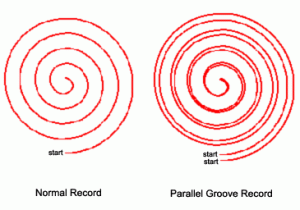
A Trick Grooved LP
Potentially the most unique concept ever applied to records was placing two grooves on a vinyl platter with differentiating tracks. When a needle is dropped onto the disc, one of two grooves will be caught by the stylus and played, adding an element of suspense, or annoyance, to your listening session. Surprisingly, this is relatively easy to manufacture when pressing a record but the downside is the length of recorded material on a two grooved disc. A normal record with a single groove typically holds, at most, 20-25 minutes of music on one side. If a second groove was used, each groove could then hold 10-12.5 minutes of music ” not 20 minutes each.
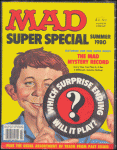 Trick grooves have been utilized in record pressings for decades, with Monty Python, Cheech and Chong and a slew of horse racing and gambling records being the most notable examples of commercial releases. The latter discs would have dozens of small little grooves to simulate different outcomes. MAD Magazine, always known for being hip to all things offbeat, included a flexible eight grooved 7 disc for their 1980 Summer magazine special that had different endings recorded for the same song. As a consumer, it is enjoyable to own and discover hidden tracks but in this case of a certain Monty Python LP, the trick groove was never mentioned so countless people, including myself, were unaware of the other track until the needle picked it up by accident.
OurStage blogger extraordinaire, Munson The Destroyer, recently tipped me off about Tool’s use of dual groovery on the LP release of Opiate, wherein the second side has a trick groove that will either play a studio track or a live track. He had this to say about the gimmick:
“I think it enhances the disk overall, since it provides a dimension other vinyl does not have. I am an advocate of fresh, interesting, and unique.”
BACKMASKING & BACKWARD MASKING
 It’s 2 A.M. and your inebriated friends are sitting around the turntable manually spinning a copy of Led Zeppelin IV backwards hoping to decipher Robert Plant’s haunting ode to Satan. Unfortunately, greasy fingers and questionable hand-eye coordination equal the record playing somewhere between 8rpm and 59rpm with no decipherable message. The process of recording vocals and messages in reverse, known as backmasking, had been quite common for the past few decades and was even outlawed in certain states in the 1980s due to court cases involving devil worship, suicide and brainwashing via subliminal recorded messages.
 Prior to all that hootenanny, The Beatles were one of the originators of this method on commercial releases. With the acclaimed (though what Beatles LP is not acclaimed?!) Revolver, Lennon and company experimented with reverse vocals being included on the actual songs. Sgt. Pepper’s Lonely Hearts Club Band included a dog whistle and an infinite loop of laughter recorded into the dead wax (next to the label) on British pressings of the LP. When making the White Album though, The Beatles hid messages in the grooves regarding the rumors of Paul McCartney’s death that could be heard when the record was played backwards. Led Zeppelin, The Eagles, Pink Floyd and even Slayer all allegedly recorded backward messages into certain songs providing their fans with endless hours of fun searching for these cryptic, and sometimes humorous, additions. In this day and age, many turntables come with reverse motor switches and contemporary recording software has the ability to reverse sound with the click of a button, practically abolishing those late night discoveries.
THE CD-VINYL

It's a CD- No it's a Vinyl! No, it's Both!!
The resurgence of vinyl in today’s market allows more creative minds to brainstorm new ways to package an old, yet time-honored, product. The creators behind French DJ Wax Tailor’s latest single took things to another level by morphing two fierce enemies into one universal product”the CD-Vinyl! Released back in June of 2009”featuring the single from his new album In The Mood For Life”the unique format is a compact disc with grooves on top so both the laser of a CD player and the diamond tip of a turntable needle can play the contraption. Skeptical? We are not talking audiophile quality on the vinyl. In fact, Wax Tailor stated on his Web site, I wanted to release this special format for the symbol about the vinyl that I defend & because I found the concept interesting. At the end I love the object, it’s fun but the vinyl part pressing is really under the expected quality of a usual vinyl.
Ultimately, a product like the CD-Vinyl becomes just another cool and interesting thing to collect ” which in the vinyl family, is an addiction that is nurtured. The above mentioned extras one can employ when manufacturing a disc are nice but merely luxuries when deciding to press a record. Time and budgets are tough so making the decision to do a run on wax can be costly enough without the additional expenditures. As the market for new vinyl continues to increase though, there will be more competition on the racks, both physically and digitally, for consumers to choose from. Adding some extra bonus material to your release might turn someone on to not only your music, but the glorious vinyl format.
Keep Digging!
-Gregorious-