
Wanderlust Audio: Greece
posted in: Features
 Crossing borders comfortably takes practice, to say the least. There are new languages (and as I’ve painfully discovered, new alphabets too), odd customs and seemingly barbaric laws. But no matter what tangled culture you travel to, a few cozy constants will always remain. One of these constants is the universality of music. These past few weeks have taught me that regardless of creed, a well-crafted rhythmic pulse is contagious. A soaring melody is still inspiring no matter what language the lyrics are scribed in. At all points around the globe, music ” no matter the medium or setting ” still brings people together.
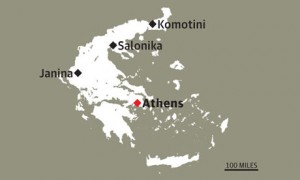
Thessaloniki is under the name Salonika on this map
Thessaloniki is Greece’s second-largest city (next to Athens), but is its capitol in terms of fashion, music, literature and general intellect. Of course, a microcosm of nearly every music scene can be found in just about any moderately-sized city, but a few tend to blare more loudly. Here, the most visible scene is an odd one: Late ’80s rock. If the near comedic levels of leather jackets and long hair (all too often approaching mullet categorization) didn’t give it away early on, then it was my first introduction to performance in a public setting that did. During my first day I sat in a café while the owner played an entire Scorpions CD over the loud speakers. Later I went to two shops that were playing good ol’ G’n’R. Although my worst fears about most popular music here being nothing more than American permeation have almost come true (they even played The Black Eyed Peas‘ ubiquitous “Gotta Feeling over the loudspeakers during the sacred Carnival parade), Greeks tend to hold their own when it comes to Pop charts in their country.

Pavlidis Pavlos
One of my first days here I walked past a record store called Stereodisc, and couldn’t help but wander inside. The window display racks were roughly 50% American 50% Greek/International, but inside they had the floors split between nationalities: the second level for American music and the lower level for everything else. It wasn’t long before I chatted up Mena, the store owner, and asked her to play me some commercially-successful Greek music. Her first pick was Pavlidis Pavlos , a Greek star she described as the John Mayer of Greece. If John Mayer were about ten years older, sadder and more minimal, then I would agree with her.

Elena Paparizou
After confirming my beliefs about the city’s hair metal / fringe punk attitude, she told me that the majority of rock music on the pop charts in this country are similar to John Mayer / Jack Johnson. That is, they are predominantly acoustic, sensual and, in most cases, do indeed rely on some aspect of their image for sales. Nikos Kourkoulis is another one of said artists, and Elena Paparizou is a good example of a Greek female Pop star. Next, Mena told me the rest of the pop charts mostly consisted of typical Euro house / techno jams. Since our talk, I’ve discovered this is what most male youth in the city listen to. When I questioned my classmates about house music, I heard a lot of I live for ˜House Music,’ and I can’t get enough of the pumping bass, etc. As we Americans know, metalheads (and just about any other radical activity that is worthy of being defined as extreme) tend to replace the prefix hard with the letter x  whenever they are feeling especially destructive (i.e. hardcore becomes xcore). In Hardstyle music, Greeks perpetuate this practice by replacing all “C” sounds with a “Q”. For a real life example of this dedication, see the picture on the left. It is my Greek friend’s tattoo, and as you can see, it says “Qlimax” which is a “Hardstyle” music event and is simultaneously meant to symbolize the peak of life.
Another trait I have identified solely with the youth of this country is that of illegal downloading. Yes, it is just as pervasive here as it is in the states, if not much, much more so. When I asked my friends if they downloaded, they responded by telling me they’d never purchased a CD in their entire lives, and said You can do whatever you want on the Internet, since, in Greece, it is still completely void of any authority.

Nikos Kourkoulis
This means that music is more accessible than ever. And while people still go to shows here ”mostly in smaller cafes and clubs, not large venues” the fact that they rely solely on Youtube and downloading for literally all music access was a little unexpected. As the whopping 17 euros exchanged hands, I was suckered into purchasing the Pavlidis Pavlos CD, I couldn’t help but see where they were coming from.
When I asked my record store friend if her business suffered from illegal downloading or from digital retailers like iTunes, her response was astonishing: No. We do very well. In an age where physical retailers are dropping like flies, this might be the first time I’ve heard such an utterance but her reasoning makes sense. The majority of Mena’s customers are middle-aged people who don’t have the capability or knowledge to download music and don’t know “what’s hot” in general. They come in to her store, describe the music that they have and enjoy and expect her to sample some new material for them. In this country a record store employee plays a much larger role in the purchase of the product which is why Mena justifies charging higher prices. This concept is not foreign in the States as the middle-aged demographic and baby boomers with money still do pay for their music. They just do it online. But the people of those corresponding demographics in Greece do not live with computers as staples of their daily lives.
That’s all for this city’s scene, folks. If any of you want to give some Greek music a listen through their online radio stations, you can do it from this Web site. We also have the following Thessaloniki bands on OurStage: Marsipus, Ixtheis, Loonattack and Techsoir. Check out the playlist below if you’re interested in their sound. Tune in on Sunday, March 14th for my profile of the Serbian musical atmosphere and Q&A with a well known Serbian band!