
Backtracking Forward: Beatles Butchered
posted in: Features
 The Beatles are one of the most collectible bands in terms of physical objects. The market for Beatles records, books, toys, posters and memorabilia has always been strong through the years ” so much so that consumers of this hobby are commonly referred to as Beatards. Out of the thousands of Beatles-related collectibles that exist, there is one item that has achieved a certain holy grail status in not only the Beatard world but the mainstream public as well ” the butcher cover. The Beatles butcher cover not only represents an aspect of why hunting for rare records is addicting and intoxicatingly fun, but it also highlights the bumbling of a major record label and its long term effect on the digging community.
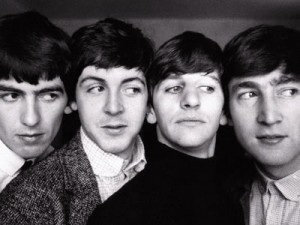
As with any item that has been deemed collectible in its respective market, there is a story behind the butcher cover’s origin. In 1966,Capitol Records was preparing to release its tenth US album by the Beatles, titled Yesterday and Today. The band hired their close friend, photographer Richard Whitaker, to shoot a photo session for the single Paperback Writer, which would be on their forthcoming US LP. Instead of the usual uninspired and promo-friendly record photo sessions the Beatles had endured, Whitaker took a more surreal direction and captured the band in various situations with unlikely props that were not the norm for this beloved rock band. Within the span of that photo session, John, Paul, George and Ringo adorned butcher smocks and draped their bodies with raw meat and plastic baby dolls while Whitaker snapped away with the camera. Two other ideas were conceptualized during that session and Whitaker intended to have all three scenes shown together as one piece of album art with various touch-ups, additions and embellishments airbrushed in later.
When Capitol Records was ready to release Yesterday and Today, The Beatles pushed the label to use the butcher image for the artwork despite hesitation from the bigwigs. Advance copies were sent to some DJs and retail store owners, and the album was to go on sale just a few days later. Several hundred thousand copies were printed and a few stores received shipments of the LP when Capitol buckled under the pressure. Hoards of store managers and DJs cried in protest over the cover, deeming it offensive and refusing to play it or sell it. All copies were immediately recalled back to the pressing plants to be destroyed. Though many of the jackets met their fate in landfills, Capitol eased the financial loss by pasting over a new photo on the butcher covers and resending those copies back to retailers. Subsequent pressings were then printed with the new photo that showed The Beatles standing, and sitting, around an open steamer trunk.
Since the Beatles were America’s darlings, this bumbling on the part of Capitol Records did not go unnoticed in the public eye. People hip to all things Beatles tried peeling off the trunk cover slick to reveal the butcher cover on their copies. Most of the time this was done unsuccessfully and people permanently ruined the album art. As time went on, the market for Beatles’ collectibles skyrocketed and all the foreign, oddball and unique pressings of their records became highly sought after, including the butcher cover. As a result of Capitol Record’s recall and remedy, collectors developed three classifications to identify original copies of the butcher album on the second hand market” first, second and third states.
A first state butcher album refers to an original copy of Yesterday and Today with the butcher image on the front. These copies were the ones that were sent to DJs and store owners, kept by Capitol Records employees and the handful that were sold in stores before the recall. First state butcher albums are ludicrously rare in today’s market and almost never surface, especially not in good condition.
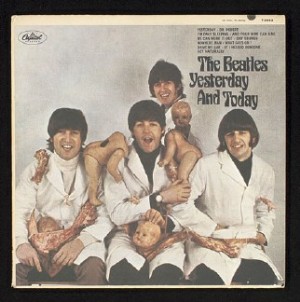
First State Beatles Butcher Cover
A second state butcher album has the new trunk cover slick pasted over the offensive butcher picture. These were the copies that were recalled, fixed and then shipped back to record stores to sell. Second state covers surface the most in the record community and cause any collector’s adrenaline to rise for a millisecond when they find an original, rainbow label pressing of Yesterday and Today. (After years of inspecting dozens of copies of this album I have found while digging, I finally uncovered an original second state butcher just a few months back. My heart stopped for a second)
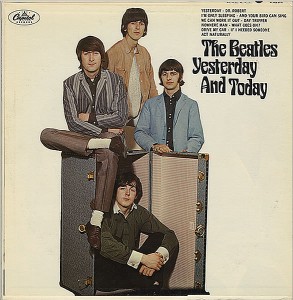
Second State Butcher Cover
A third state butcher album is an original copy that had the trunk cover slick peeled off the jacket to reveal the butcher cover. The majority of hasty collectors who attempted peeling their covers of Yesterday and Today ruined their copies due to lack of knowledge of how to perform this delicate operation. There are a handful of entrepreneurs in the world who have advertised themselves as professional butcher cover peelers. Having studied the glue that Capitol Records used to paste the new slicks, these experts can successfully restore a butcher copy of Yesterday and Today to its original cover.
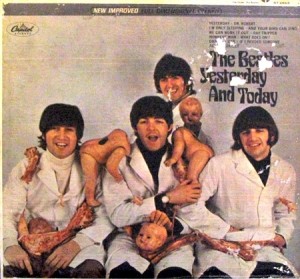
Third State Butcher Cover
There are certain tell tale signs to determine the authenticity of an original butcher cover. Due to the rarity and demand for this collectible, countless fakes and reproductions have flooded the market so becoming educated is the first step to starting the hunt. The three obvious clues are:
1. On the back of the album jacket, in the lower corner, the number 2, 3, 4, 5 or 6 is printed, indicating the location of the pressing plant where the record was manufactured. Later pressings did not contain this number.
2. On the front cover, in the blank white space of the trunk photo, the black from Ringo Starr’s V-neck shirt can be seen through the paste over slick.
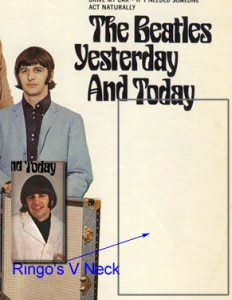
Ringo Starr gives it away
3. The front of the jacket will not have a gold record seal in the right corner. Yesterday and Today went gold in the US a few months after it was released and later pressings printed this seal in the corner.
There are a number of myths associated with the butcher cover and the subliminal messages it was meant to portray. Everything from the band’s criticism of the Vietnam War to their unhappiness with Capitol Records are rumored reasons for using the butcher photo on their album. Though members of the group insist it was the photographer’s idea, sometimes it’s more enjoyable to nurture a myth rather than disprove it.
Keep Digging!
-Gregorious-