
Backtracking Forward: Bucket O' Blues
posted in: Features
 Throughout the first few decades of the 20th century, the raw, stripped-down sound of blues was played in various nooks and crannies as musicians from the north, south, east and west traveled the crossroads of the United States. These early players laid the framework for future blues musicians jumping on the bandwagon and also influenced jazz and rock acts as they incorporated the emotion and soul of the music into their own playing styles. By the mid-to-late 1960s, the veteran blues players were slowly dwindling while the electric guitar-soaked rhythms of rock were adapting the genre in new ways. By the 1970s, raw and gritty blues recordings were largely a thing of the past as funk, soul, disco, metal, punk, and rock and roll dominated listeners’ ear drums. The blues harp, the washboard and masterful slide guitar skills were no longer in the spotlight and remained dormant beyond small circles of devotees.
Enter Portland, Oregon’s Sidestreet Reny.

To say that Reny and Lil’ Bell, the two architects behind the infectious sounds of this week’s “Backtracking Forward” post, have sparked a roots revival is not entirely true”the first 10 years of this century alone have seen a profusion of talented, independent musicians paying homage to the rustic blues. But these two lovebirds have hit upon a chord that echoes with the fire of that vintage sound yet splices hints of hip hop, rock, reggae and folk into one authentic package delivered with contemporary zeal. Although their music exists in a 21st century reality, it’s not hard to imagine them performing 80 years ago and being as thoroughly enjoyed by the public as they currently are now.
 A subject matter that Reny and Bell share intimately with the blues legends is the struggle of the independent musician and the curse of money. It seems like every performer on the original blues circuit crooned a melody about greed, money and the struggle without it. Rather than commiserate, a song like Money Blues gives a voice to their plight as well as every other musician that has been afflicted by the need for green. From the opening pluck of the guitar string to the moan of Reny’s voice, this song captures that aching ambition to live free in a society ruled by currency. Reny achieves that crisp and authentic sound by using a National Resonator guitar. The Resonator guitar is constructed of metal and not wood, allowing its notes to resonate and project 10 times louder than its wooden sibling. Think that sounds good coming from your computer? Listen to one of the original blues recordings on 78 rpm (a Paramount or early RCA perhaps) and experience the power of analog recording.
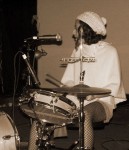 The vocals of Arthur Big Boy Crudup, Bukka White and a slew of others helped define the raw blues sound of the early part of the century. After hearing Sidestreet Reny though, one can’t help but be sweet on the harmonizing from Lil’ Bell behind the drum kit. Imagine if Crudup had female backing vocals behind his songs? Perhaps it wouldn’t have worked but as Reny hunkers down behind his National Resonator and unravels a unique conglomeration of genre-influenced vocals, Lil’ Bell’s magic voice always chimes in and adds a level of charm not heard in her counterpart’s lead. Couple that with her steady beat on the drum and this animated female helps balance the rawness of Reny’s presence.
If Sidestreet Reny was merely a delta blues throwback group, their musical contribution would be warmly accepted into the circle of blues aficionados. A characteristic that makes this duo stand out though is the incorporation of hip hop, folk and reggae vocals courtesy of Reny” all of which help branch their sound into the ears of non-blues enthusiasts. He has the remarkable ability to slide between the coarse tones heard in veteran delta musicians from the south to a smoother and quicker flow traditionally found in dancehall and hip hop MCs. The track BK serves as a pristine example of Reny’s vocal blending as he takes the listener on a memorable ride through the streets of hometown Brooklyn, NY with a twangy and infectious rhythm as the backdrop.

Had Elmore James, Son House and all those cats been given access to today’s technology back in the 1930s and 1940s, one might have received Facebook pokes from John Lee Hooker himself while Robert Johnson updated his Twitter status with, Met a man at the crossroads today¦ Despite Sidestreet Reny‘s antiquarian and classic image, they do utilize the Internet to its greatest potential in order to reach a wider audience. Their homepage has the most recent album available for streaming, as well as links to purchase three other masterpieces they have worked on over the years. The duo is represented on Facebook, Twitter, YouTube, MySpace, OurStage and a slew of other networking sites that open up their sound to a global audience.
By now, the OurStage blog readers know that the author of this column is a vinyl addicted nut”so much so that his CD player stopped working 6 months ago and a replacement is not on the horizon. Every artist talked about on “Backtracking Forward” deserves to be heard on vinyl and with today’s resurgence of the analog format, this has become more of a reality for the performers whose music strikes a chord with this writer. In the case of Sidestreet Reny, it’s time to break out the shellac and press up a super limited edition 10 platter for the fans because there ain’t no better way to listen to the blues than at 78 rotations per minute.
Keep Digging!
-Gregorious-