
Backtracking Forward: Spotlight On Phil Ochs
posted in: Features
Names like Woody Guthrie, Pete Seeger, Joan Baez and a young Bob Dylan are synonymous with the origins of folk music. In particular, Dylan and Baez are heralded as folk icons of the 1960s and will forever go down in the books as musical heroes and purveyors of the sound. However, there existed another man whose unabashedly direct songs became the under-appreciated anthems for the anti-war movement during the decade. Phil Ochs was his name, and he fought battles of racial inequality, war, the draft and corruption with only a guitar and pen in hand.
Wait a second, Phil Who?? Existing on the fringe of the high pedestal where Dylan and Baez stand, Ochs is a man who used his journalistic nature to craft modern day folk songs meant to incite and inspire individuals to open their eyes. He was a writer who saw injustice paraded in front of everyone’s faces and who vocalized his outrage. He was also a man that succumbed to serious mental instability and suffered through depression, addiction and delusion in his later years, ultimately taking his own life.
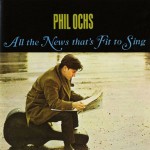
- All The News That’s Fit To Sing
Ochs’ first two LPs for Elektra Records, All The News That’s Fit To Sing (1964) and I Ain’t Marching Anymore (1965), are absolutely stunning acoustic recordings that feature only a guitar and a voice that is pleasant to hear yet lyrics that are jarring, yet motivating, once comprehended. Songs about racism, labor unions, socialism, Marxism and protest all exist cohesively alongside two songs in poetic verse. Wherein Dylan and Baez leaned more heavily on poetic song structure, Phil was much more blunt with his writing and therefore stood out from his counterparts. His earlier Elektra recordings are very topical in nature due in part to his background as a journalist and writer at Ohio State University. Ochs had a knack for picking up the newspaper and crafting compelling songs about domestic and international affairs; songs that could make one laugh, sing in chorus or contemplate the blatant atrocities being committed.
Here’s to the people of Mississippi
Who say the folks up north, they just don’t understand
And they tremble in their shadows at the thunder of the Klan
The sweating of their souls can’t wash the blood from off their hands
They smile and shrug their shoulders at the murder of a man
Oh, here’s to the land you’ve torn out the heart of
Mississippi find yourself another country to be part of
-From the song “Here’s To The State Of Mississippi”
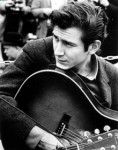 While folk superstars Dylan and Baez escalated into household names, Ochs failed to reach the notoriety gained by his fellow musicians. Since both Ochs and Dylan called Greenwich Village home, it was known that they shared an on again/off again friendship. Tensions between the two reached a breaking point when Dylan infamously kicked Ochs out of a limousine and declared You’re not a folksinger. You’re a journalist. By the later half of 1965, changes in the folk circuit affected the music industry as a whole. That summer, Dylan left his mark by premiering his electric sound at the Newport Folk Festival, and soon after released the seminal Highway 61 Revisited. This innovative disc, which featured a cast of incredible musicians like Al Kooper and Mike Bloomfield, broke new ground and influenced an aspiring generation of musicians to amplify their sound therefore distinguishing themselves from the acoustic folk movement. NYC was no longer the legendary bastion for folk musicians as rock and psychedelia began to grow stronger roots.
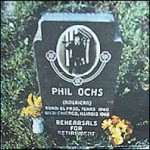
- Rehearsals For Retirement LP
By 1967, Ochs left Elektra Records and the struggling NYC folk scene, and signed to A&M Records in Los Angeles where he recorded a few albums”most notably Pleasures of the Harbor. It was there he opened up his writing to include more instrumentation and arrangements coupled with personal, reflective songs that distanced his sound from the folkies. He tried to appeal to a more pop-oriented crowd on some tracks, like Outside of a Small Circle of Friends, yet also retained some of his characteristic song writing from his Elektra years. As he continued to record for A&M though, his songwriting began to hint at signs of oncoming depression, death and despair. The riots and brutality surrounding the 1968 Democratic Convention in Chicago, where Ochs performed, also had a profound effect on his life and his role as a political troubadour as evidenced by the cover for his 1969 release Rehearsals for Retirement which depicted his own tombstone with the date and place of death being Chicago 1968. Many critics said that this was the death of Phil Ochs as a political folk singer and in some part this was true for the scant material he recorded and performed in 1970 and beyond took on interesting rock and roll flair, modeled after the likes of Buddy Holly and Elvis Presley.
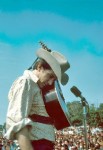 The 1970s were a grim period for the commercial appeal of Ochs’ music and his personal life. Leading up to his death in 1976, Phil traveled throughout the world, becoming politically involved in Chile in the early 1970s and spending some time in Africa in 1972 where he performed with local musicians. Battling depression, alcoholism and drug addiction, he continued down a dark and lonely road where he no longer wrote or recorded any new material. Though the Vietnam War continued to rage throughout the early 1970s, interest in anti-war folk songs and their artists had waned dramatically. By 1975, the war was officially declared over but Ochs had already mentally checked out and in 1976, he committed suicide by hanging himself.
Hello, hello, hello
Is there anybody home?
I’ve only called to say
I’m sorry.
The drums are in the dawn,
and all the voices gone.
And it seems that there are no more songs.
-From the song “No More Songs”
Pete Seeger, Dylan and Joan Baez all continued their careers as musicians. Seeger and Baez, in particular, are still very outspoken regarding political rights and injustice throughout the world. As for Phil, though his music has lived on through staunch supporters and contemporary bands paying homage to his songs, his name has been on the fringe of remembrance. But for those who desire to dig deeper through the commercial history of the folk movement and get to the meat and bones of what the 1960s Greenwich scene was all about, should pick up some Phil Ochs vinyl or the comprehensive, highly recommended CD boxset Farewells and Fantasies from Rhino Records.
It is wrong to expect a reward for your struggles. The reward is the act of struggle itself, not what you win. Even though you can’t expect to defeat the absurdity of the world, you must make that attempt. That’s morality, that’s religion. That’s art. That’s life.
-From the liner notes of The Broadside Tapes 1 on Folkways Records
Check out this playlist for a sampling of outspoken OurStage artists who carry the torch and stand up against injustice through their music. Though not all are in the style of Ochs, their message helps keep the spirit of the 1960s folk movement alive.
Keep Digging!
-Gregorious-