
Q&A WITH MARTIN ATKINS
posted in: Features • Music News • OurStage Updates • Rock
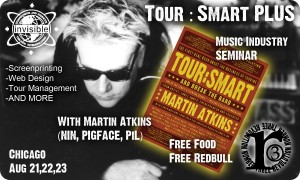
Martin Atkins is the quintessential punk rock renaissance man. He’s been a member and/or session musician for some of the most influential names in alternative music; specifically the post-punk and industrial genres. Founder of Invisible Records and author of “Tour: Smart”, Atkins is also a professor at Columbia College and is leading a DIY music business revolution through his seminar series Revolution Number Three. In between revealing the mysteries of how to have a shot at a career in music, Martin Atkins had time to answer a few questions for OurStage.
KB: Having toured with bands such as Public Image Ltd., Killing Joke, Ministry, Nine Inch Nails and Pigface, you’ve performed for audiences at sold out stadiums as well as in intimate settings for the discerning few. What has been an epic moment for you in terms of live performances?
MA: Well, there are a LOT. Helicopters and riot police on horseback in LA in the early 80’s (PiL) to stadiums in Europe with Killing Joke¦ small sweaty places, seven drummers onstage with Pigface¦there have been many epic moments but it’s the tiny intimate experiences that I remember most. Like the coffee shop in Florida where we projected my lecture slides onto some old curtains thrown over some plywood in the front garden, hanging out before an event and meeting everyone in the crowd ” that’s the stuff I like. The shows where the audience becomes one huge vibrating mass are GREAT but have a sheen of something or other, an impenetrability of the audience fueled by distance and inaccessibility that frustrates at times.
KB: In contrast, what was a less-than-shining moment in your career as a touring musician?
MA: Oh God, back in my drinking days I messed up a Pigface show in New Orleans. I thought that we had already played. We hadn’t and I was in bad shape. It was a tiny club and fortunately a few people in the crowd threw some shit (cigarettes or glasses or both) so we bailed to avoid further embarrassment. Fortunately it was only a handful of people. I think that its captured on the Son Of A Glitch Pigface video.
KB: You’ve also been on the label side of the music business, in academia and are a published author of the book Tour:Smart. With your varied experiences (and expertise) why did you choose to write about touring?
MA: Well, that’s EASY. When I started teaching at Columbia College here in Chicago, the text book they were using was written in 1962. That just seemed outrageous! So I started to bring in my own materials to classes and put together a traditional text book fairly quickly. It was the human element of touring, the poetry, and the stress that really took a while to capture”with the help of about 100 other peoples’ input. Then I realized that most of the people I wanted to read it would be A.D.D. like me so I added in tons of graphics. That took a while too but I’m very happy with the end result and the reactions to it.
KB: Your book is a virtual survival kit for musicians. What piece of wisdom can you share that is applicable for both weekend warriors and road dogs?
MA: Have more than one t-shirt! Which leads inevitably to: TEACH YOURSELF TO SCREEN PRINT! Once you have a RANGE of items to sell you are doing several things effectively. First you’re fueling the people who have been interested in you from the beginning, the ones who already have the album and the first crappy shirt you did. Second, you are creating more choices for new fans. It’s all about TINY steps that make a difference.
KB: What is a quintessential misstep that musicians make when it comes to touring?
MA: ALWAYS choosing a venue that is five times smaller than their audience ”always!!! The end result is that the 50 people that like you now feel like they are idiots because they are following a band that no one likes. Fifty people in a 400 capacity club is a catastrophe. Fifty people on a Monday night in a sweaty 100 capacity bar is a blast!! You can build on a small success; you can’t build on a large, highly visible failure! The worst thing that can happen when you choose a venue that’s too small is that you SELL OUT a show! That’s a worldwide yardstick of SUCCESS!!!! No one (except me) ever asks what the capacity of the club was!
KB: Going back to your career as a musician, it seems to me that most of the bands you were in created music that first appealed to a subculture of fans and later became embraced by broader audiences. Did you ever care about mass appeal?
MA: I think that caring about mass appeal is a recipe for disaster. You’ll start to compromise everything and compromise doesn’t work. You need to have a singular vision (one person or a band collectively) that stands out from the pack (and the pack is getting larger every day!) I think that just about every band starts out as a tiny subculture. For instance, I saw U2 perform to 17 people in a basement bar in London. It’s only when bands edit their own histories that we are led to believe that there is a simple, quick path to success.
KB: Can you contrast the experiences of making music that has received mass appeal versus that which garnered underground acclaim?
MA: Well, for the reasons mentioned above, not really. I just make music (or produce it) the way IT wants to be or that the social structure around it resonates (my China Dub Soundsystem album for instance). This Is Not a Love Song was a big hit for PiL, but it was just one song off of a quite experimental album. It has horns on it which might seem like an attempt at commercially but for PiL horns were kind of risky. We were quite surprised when that song became a worldwide hit. Someone just used it in the film Waking With Bashir of all things!
KB: What’s next for Martin Atkins?
MA: I just opened a new school called Revolution Number Three. It’s a reaction to the state of traditional education which doesn’t make sense any more. I’m experimenting with some new ideas and some new people to help me realize the potential of all of our businesses: label, studio, music publishing, book publishing, sound library, art gallery, etc.). We’re opening them up to be student run. It’s pretty cool and so far the results are spectacular. It’s a LOT of work though”a LOT of work” because we CARE and we are paying attention!
Martin is offering a discounted rate to OurStage artists interested in attending Number Three Revolution in Chicago August 21-23. Find out more HERE.